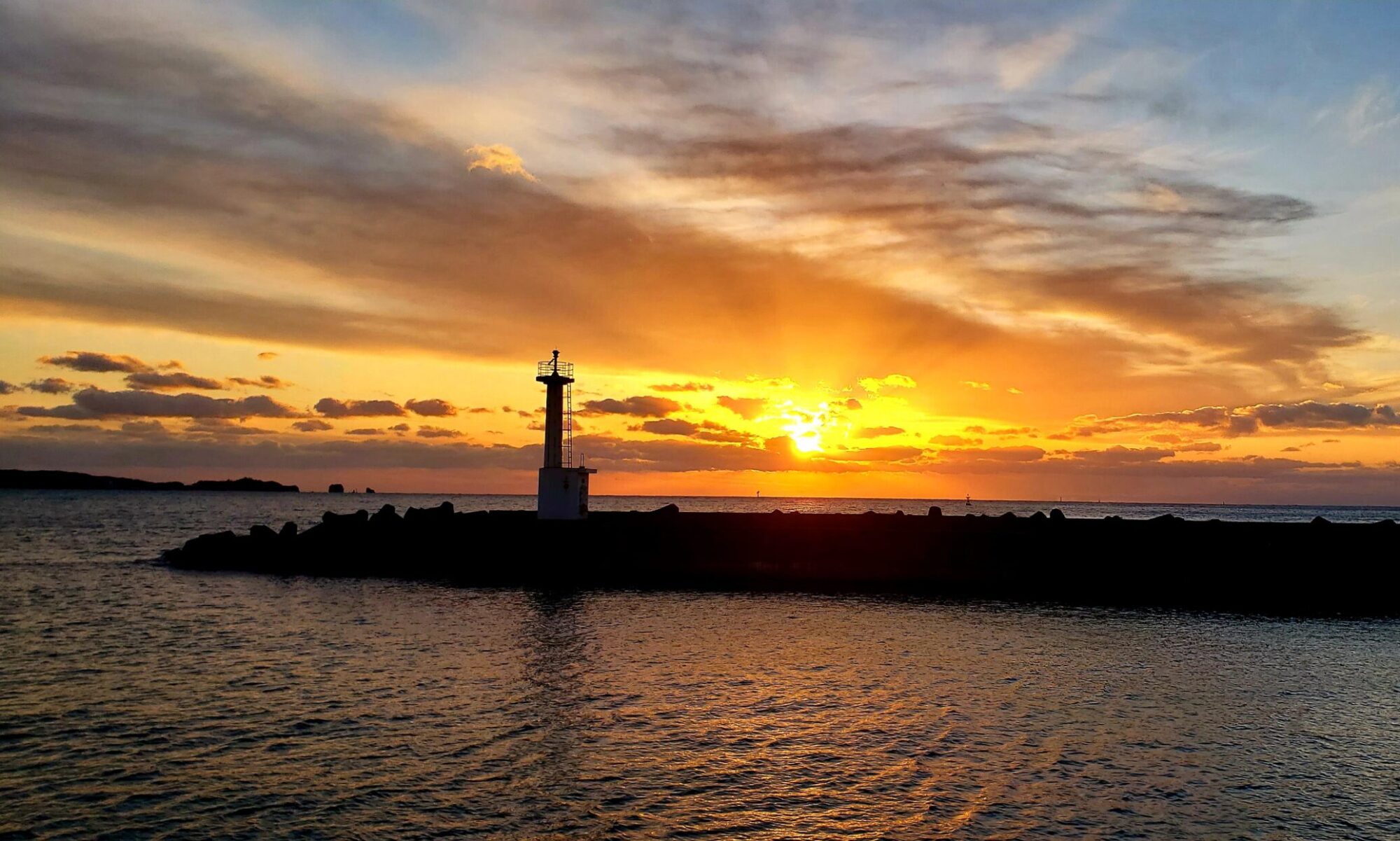
Chigasaki Beach on New Year’s Eve had a clear air and the last sunset and sunset of the year was very vivid. There were so many people on the beach that they watched the last sunset of the year. I wish you all the best next year. Thank you for stopping by the chigasaki Sunset Museum this year. I look forward to working with you again next year.
After visiting Kenchoji Temple in Kamakura, a famous temple of the Rinzai sect, I climbed Mt. Shojoken in the precincts and watched the sunset. I could also see Kamakura Gakuen below. I sang the words to the classic Southern All Stars song, ”Bid farewell to the sunset’. Sagami Bay can also be seen beyond Wakamiyaoji Street. It was a beautiful sunset.
Its official name is crepuscular rays. It is also called an angel’s ladder or Jacob’s ladder (derived from Genesis). Since a strange cloud covered Sagami Bay in the morning, I climbed Shonandaira, a scenic spot in Shonan, and waited for dusk. As I aimed, an angel’s ladder descended from a gap in the clouds above the Izu Peninsula and the sea surface off Odawara began to shine like a spotlight. I enjoyed the mystical scenery that reminds me of the movie ‘Close Encounters of the Third Kind’ for a while.
I enjoyed the Koharubiyori of Mt. Azuma in late autumn. Mt. Azuma near Ninomiya Station on the JR Tokaido Line is a small mountain 136 meters above sea level with a wonderful view overlooking Tanzawa, Fuji, Hakone, Izu Peninsula, Oshima, Miura Peninsula and Sagami Bay. How is Chami, the idol cat of Mt. Azuma in Scottish Fold walking up to the top of the mountain? It was a beautiful sunset.
Ritto has come again this year. It is said that the day of 24 divisions of the old calendar is the day when autumn reaches its climax and the sign of winter begins to appear. From now until the first day of spring is winter. The day before the first day of winter, the Chigasaki Beach saw a spectacular sunset that seemed to welcome the first day of winter.
Today is the day of the harvest moon in 2020. According to the lunar calendar, the sky is the clearest and the moon is bright and beautiful in this period of the year. As the name suggests, the beautiful moon rose on the Chigasaki Beach, entertaining the visitors.
That is the 74 th temple of Shikoku 88temple pilgrimage.This temple was founded by Kobo Daishi. The principal image is the Yakushi Nyorai.I walked about two kilometers through the countryside from Shusshakaji.Located at the foot of Mount Kabutoyama, which is covered with thick forest of trees, this temple has a clean and neat impression. The next temple is Zentsuji.
That is the 71 th temple of Shikoku 88temple pilgrimage.The temple was founded by Gyoki under the order of Emperor Shoumu. The principal image is the Senjyu Kanzeon Bosatsu, It is located in the middle of Mt.Iyadani at an altitude of 382 meters, and there were steep stairs even after entering the temple gate. The grounds of this temple are surrounded by rocky mountains and have a strong mountain atmosphere. It is said that Kobo Daishi trained himself in a cave in this temple when he was a child. From the main hall you can enjoy a peaceful view typical of Sanuki.
That is the 69th temple of Shikoku 88temple pilgrimage.It’s principal image is Sho Kannon Bosatsu. According to this temple legend, Kobo Daishi entered the temple as the seventh chief priest. It is located in the middle of Kotohikiyama Mountain, and shares the temple gate and precincts with the previous fudasho, Jinnein. When I was praying, it started raining heavily, so I took shelter from the rain in the precincts for a while. At the foot of Kotohikiyma on the Seto Inland Sea side, there is Zenigata Sunae, a huge painting famous for Kanei-tsuho. It is said that people who see this picture of sand live a long and healthy life and have no financial problems. I wanted to see it after a long time, but I gave up because of the heavy rain. I went to Motoyamaji, the 70th temple.
Shonandaira is one of the best scenic spots in Kanto. From Oiso Station on the JR Tokaido Line, go up the mountain path for two kilometers until you reach the 180 meter peak. The panoramic view is overwhelming. I enjoyed views of Tokyo Sky Tree, Yokohama Landmark Tower, Sagami Bay, Enoshima Island, Miura Peninsula, Shonan Coast, Oshima Island, Izu Peninsula, Mt. Fuji and the Tanzawa mountain range. Above all, the sunset is wonderful. There is also a historic site related to Soga Monogatari, and Mt.Komayama in front of you is derived from toraijin of Kokuri is painted in Hiratsuka juku, ‘The 53 Stations of the Tokaido’ by Hiroshige Utagawa