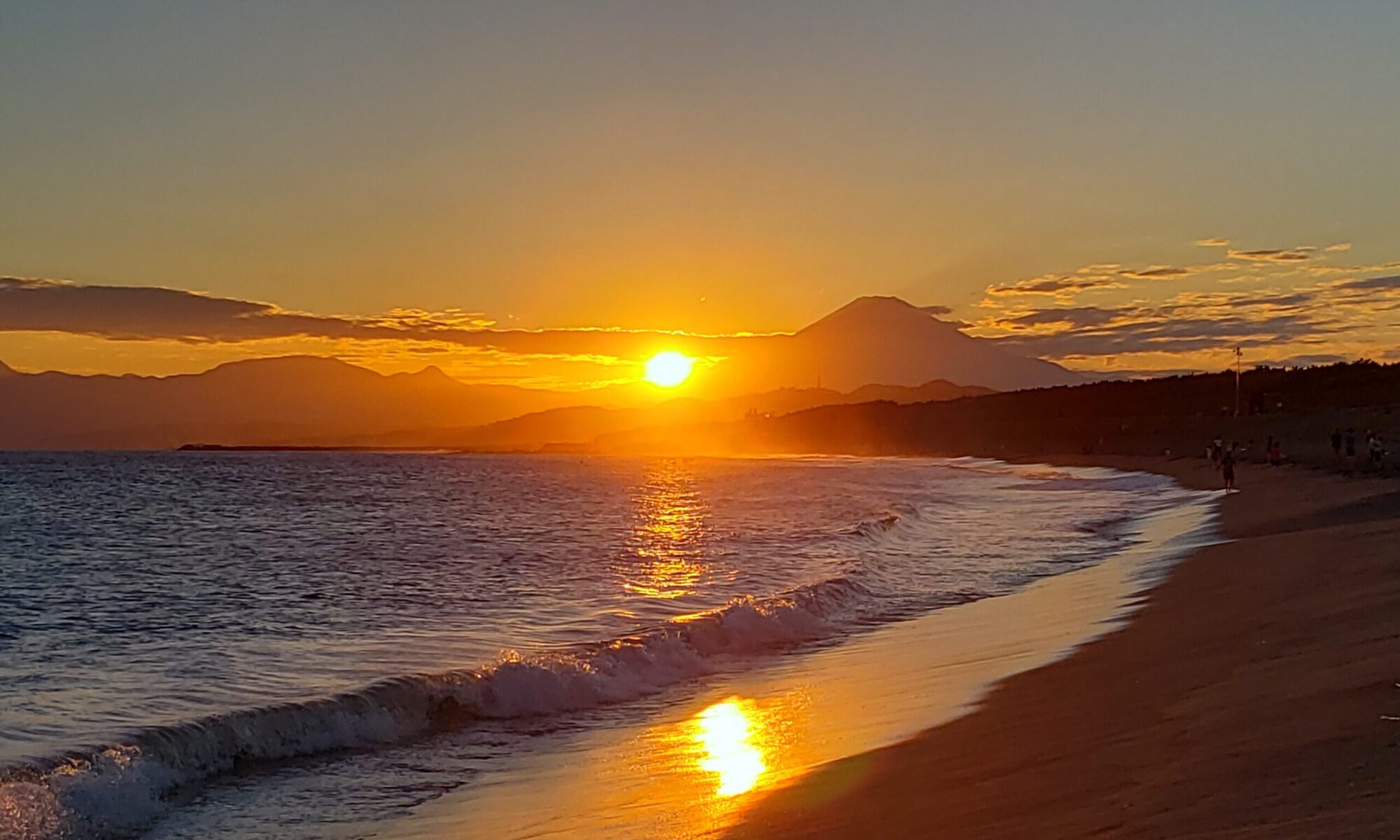
Today is the day of the harvest moon in 2020. According to the lunar calendar, the sky is the clearest and the moon is bright and beautiful in this period of the year. As the name suggests, the beautiful moon rose on the Chigasaki Beach, entertaining the visitors.
That is the 75 th temple of Shikoku 88temple pilgrimage.After Kobo Daishi returned to Japan from Tang, he built the temple on the land donated by his father, SAEKI no Yoshimichi, imitating the Qinglong Temple in Changan, China, where his master, Keika Osho, lived. The head temple of the Zentsuji School of the Shingon Sect is said to be the birthplace of Kobo Daishi and the principal image is Yakushi Nyorai. The monastery is huge with majestic buildings and trees such as the Kondo, the five-storied pagoda, and the Nandaimon gate, and is about 1.5 kilometers away from Kozan-ji Temple. I stayed at this temple’s temple lodgings for two nights and attended the morning service every day. The view of the sunset from the shukubo(temple lodgings) is wonderful. It is quite different from other fudasho temples.
A huge cumulonimbus appeared over Yamanashi on the evening of August 30. The top of the cloud is wide and flat, and it is called ‘Kanatoko (gold floor) Clouds’ because of its shape. They were seen in a wide range of areas, including Saitama, Chiba, Tokyo and Kanagawa Prefecture, and made the news. At about the same time, anti-twilight rays also appeared in Sagami Bay. From the sky above Miura Peninsula, which is opposite to the direction of the sun, light pillars radiantly extended toward Izu Peninsula. The moon appears and the scene is fantastic. I was lucky to be able to take pictures on the same day, because I rarely see these clouds and anti-twilight rays.
Risshu is the day when summer reaches its peak and the signs of autumn begin to appear. In the 24 divisions of the old calendar, Risshu is between the summer solstice and the autumnal equinox, and from then until the first day of winter falls. This year, the rainy season has finally ended for a very long time, but is it already the beginning of autumn? The days of intense heat continued, but today’s sunset at Chigasaki Beach was somewhat autumn.
That is the 69th temple of Shikoku 88temple pilgrimage.It’s principal image is Sho Kannon Bosatsu. According to this temple legend, Kobo Daishi entered the temple as the seventh chief priest. It is located in the middle of Kotohikiyama Mountain, and shares the temple gate and precincts with the previous fudasho, Jinnein. When I was praying, it started raining heavily, so I took shelter from the rain in the precincts for a while. At the foot of Kotohikiyma on the Seto Inland Sea side, there is Zenigata Sunae, a huge painting famous for Kanei-tsuho. It is said that people who see this picture of sand live a long and healthy life and have no financial problems. I wanted to see it after a long time, but I gave up because of the heavy rain. I went to Motoyamaji, the 70th temple.
It is the head temple of the Soto sect along with Eiheiji in Fukui Prefecture. It was founded in the Nara period and is said to have been founded by Gyoki. The principal image is Shaka Nyorai. During the Meiji period,this temple moved from Ishikawa Prefecture to Tsurumi, Yokohama City, Kanagawa Prefecture. The precinct is huge. There are many temple buildings surrounded by trees and monks are in training. This site was open to the public, and the citizens were taking a leisurely walk. In the midst of silence, I visited Daisodo Hall, which houses the founder Dogen and other Zen priests. I heard the sound of drums from the distant hall.Mr. Yujiro Ishihara was buried in this temple. It is close to Tsurumi Station on the JR Keihin-Tohoku Line.
Shonandaira is one of the best scenic spots in Kanto. From Oiso Station on the JR Tokaido Line, go up the mountain path for two kilometers until you reach the 180 meter peak. The panoramic view is overwhelming. I enjoyed views of Tokyo Sky Tree, Yokohama Landmark Tower, Sagami Bay, Enoshima Island, Miura Peninsula, Shonan Coast, Oshima Island, Izu Peninsula, Mt. Fuji and the Tanzawa mountain range. Above all, the sunset is wonderful. There is also a historic site related to Soga Monogatari, and Mt.Komayama in front of you is derived from toraijin of Kokuri is painted in Hiratsuka juku, ‘The 53 Stations of the Tokaido’ by Hiroshige Utagawa
That is the 67th temple of Shikoku 88temple pilgrimage.The temple was founded by Kobo Daishi and its principal image is the Yakushi Nyorai.Surrounded by farm ponds, countryside and forests, it feels like the scenery hasn’t changed since it was built 1,400 years ago. The precincts are not big, but the old trees grow here, and the appearance of the wild Buddha in front of the temple gate is attractive. It is an elegant temple.
I visited Kawasaki Daishi in early summer. Its honzon is Kobo Daishi, and its formal name is Heikenji. It is also called Yakuyoke Kobo Daishi. This temple is the head temple of the Chisan group of the Shingon Sect. It is one of the most visited temples in Japan. At dusk, Kawasaki Daishi was surrounded by silence and fresh greenery, and local people were relaxing all over the place. The precinct is large. There is a bronze statue of Kitanoumi, the fiftieth yokozuna. The five-storied pagoda is beautiful.I transferred to the Daishi Line at Keikyu Kawasaki Station and got off at Kawasaki Daishi Station. The Daishi Electric Railway, the predecessor of the Daishi Line, is said to be the origin of the present Keikyu Electric Railway.
That is the 16th temple of Shikoku exceptional Sacred Sites.The principal image is Jizo Bosatsu, which is said to have been carved by Kobo Daishi. The temple was founded by Kobo Daishi. After visiting Unpenji, go down the pilgrimage road in the mountain. This road was steep and rocky, so it was hard to walk on. Looking back, I saw the clouds hazy over Mt. unpenji.As I was hungry, I had Iya soba at an udon restaurant near Sanroku Station on the Unpenji Ropeway. This temple is also known as “Hagi-dera Temple” and as its name suggests, the temple is famous for its bush clover and there are around 2,000 trees planted in the temple grounds. It is rare for a tea house to double as Nokyosho. It is a fudasho where you can feel the relaxed atmosphere.